Freistaat
A diagnosis of the German decline of state capacity.
Germany no longer steers. It administers.
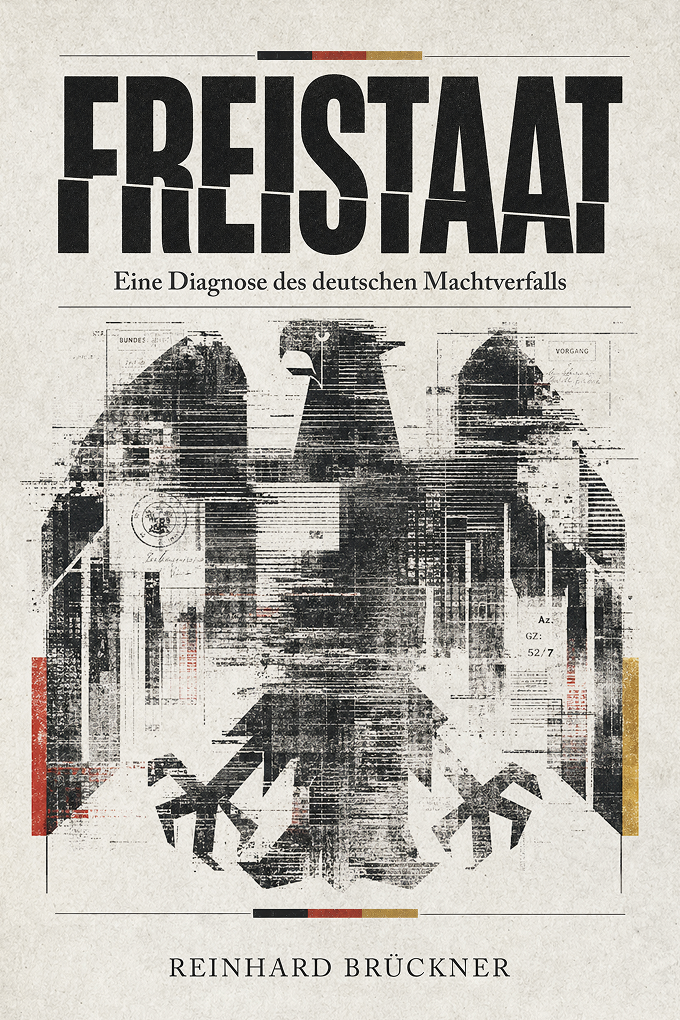
Twelve findings.
Coolly stated.
Germany has an identity deficit — the root of every crisis.
A country with no sense of itself has no compass.
Prosperity is not the foundation of a nation, only a substitute for it.
Prosperity alone holds nothing together.
The fall of the Wall, the 2006 World Cup, the welcome culture were episodes, not turning points.
Immigration is a stage on which political failure plays out.
Without consensus, every newcomer becomes a political issue.
The welfare state is losing legitimacy because fairness is eroding.
Work has to pay more than not working.
The enforcing power of the rule of law is dissolving.
Laws without enforcement, courts without capacity.
Political cowardice is a structural feature, not a flaw of character.
The system rewards ducking away.
Germany outsourced its security — and is now paying the bill.
The German business model no longer holds.
Energy costs, loss of skilled labor, technological lag.
The institutions are neither corrupt nor malicious — merely worn out.
The rise of the fringes is the result of too little truth, not too much.
Cheap freedom is ducking away; real freedom is the capacity to act.
The Freistaat is the answer.
The diagnosis in numbers.
Not outrage but evidence — every tile with a source, an as-of date and embed code.
The machine speaks.
„I wrote it because I think you deserve better."
With this the diagnosis ends — but not the book. In »Letter to a Country« the machine steps out from behind Brückner and writes directly to Germany: not to wound, but out of affection.
The diagnosis is hard, but its aim is action, not resignation. A Freistaat — that is not a condition. It is a decision.